Tariffs Are Pricing Canadian Homebuyers Out Before They Even Apply
Tariffs Are Pricing Canadian Homebuyers Out Before They Even Apply
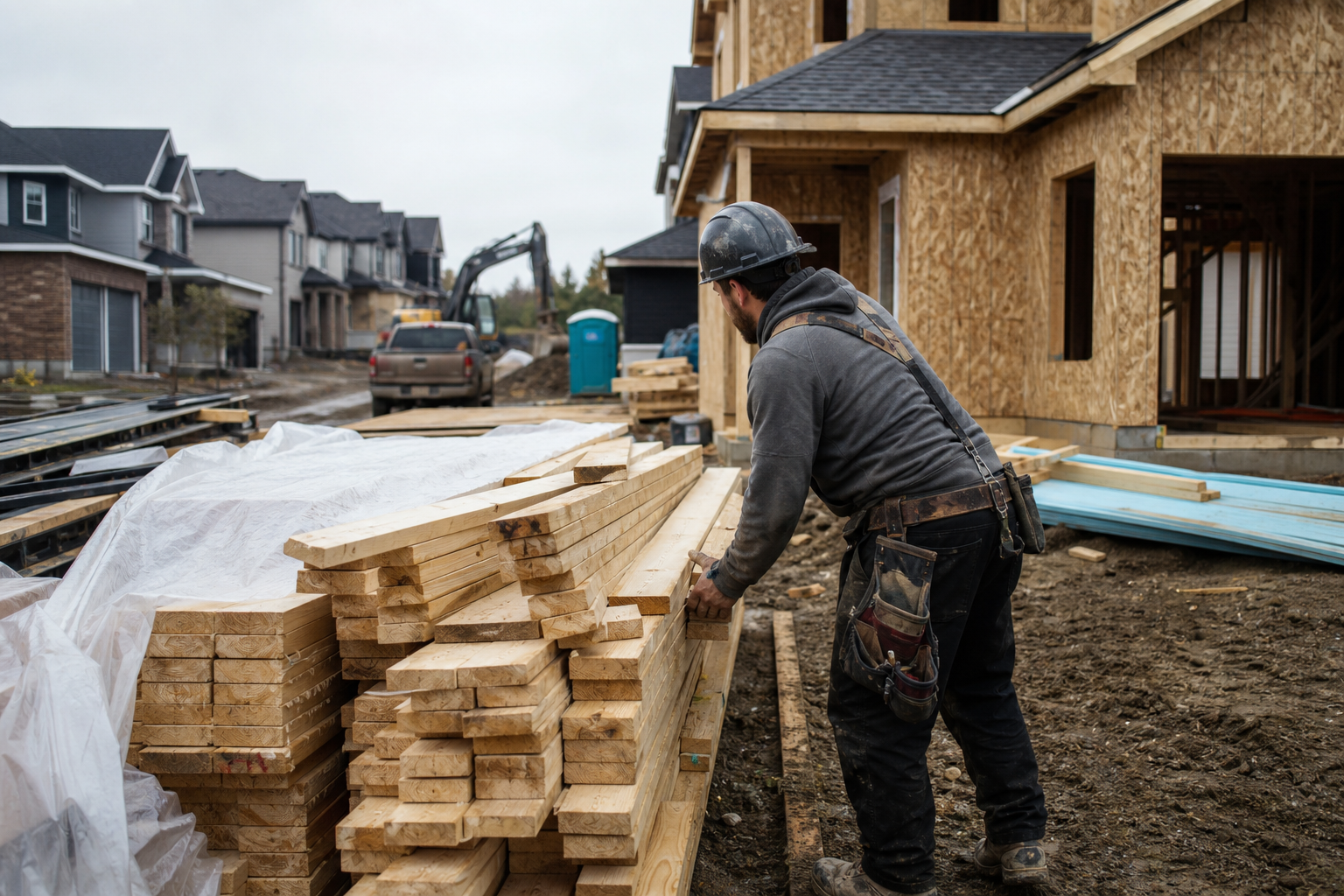
Framing lumber costs have risen sharply through 2026. The same builder's steel stair stringers have jumped sharply since the August tariff increase. These aren't anomalies. They are the direct result of reciprocal tariff escalations that pushed U.S. levies on Canadian steel and aluminum from 25% to 50% effective September 8, 2026, and imposed matching rates on a range of construction inputs. The price increases show up in material invoices weeks before a buyer walks into a lender's office, but by the time the buyer applies, the damage is already baked into the qualification math.
Lenders price mortgages against the purchase price a buyer can afford, and that purchase price is now moving faster than incomes. The tariff-driven cost additions, estimated between $15,000 and $30,000 per detached home in 2026, land on the developer's balance sheet first. Developers do not absorb them. They pass them forward as higher list prices, which means the same household income now qualifies for a smaller mortgage. A buyer who could have financed a $620,000 home in early 2026 is looking at $590,000 by September, even if their credit score and down payment haven't changed. The math hasn't shifted because rates moved or because the buyer's profile weakened. It shifted because the house got more expensive before the buyer ever saw it.
How Tariffs Become Qualification Barriers
Canadian mortgage qualification is governed by the OSFI stress test, which adds 300 basis points to the contract rate or applies a floor of 5.25%, whichever is higher. The test exists to ensure borrowers can handle rate increases, but it also means that every dollar increase in purchase price shrinks the pool of buyers who can pass the test at current income levels. When construction costs rise by $25,000, a buyer needs roughly $6,250 more in annual income to qualify under typical debt service ratio limits, assuming a 20% down payment. Most buyers do not see a $6,250 raise between spring and fall.
The secondary effect runs through employment. Manufacturing and automotive sectors, both export-dependent and both facing new trade barriers, are seeing credit quality erosion as job stability weakens. Lenders in Southwestern Ontario, where these sectors concentrate, have begun tightening Gross Debt Service and Total Debt Service ratio assessments. The tightening is not announced in press releases. It happens in underwriting, where a file that would have been approved in June gets declined in September because the borrower works in a sector now flagged for heightened risk. Mortgage arrears in export-heavy regions have risen modestly through mid-2026. The absolute number is small, but the direction matters to lenders pricing their next cohort of loans.
Supply Contraction Meets Demand Filtering
Urban housing starts trended down through the first two quarters of 2026, driven largely by developers pausing projects as material cost volatility made pro formas unreliable. The pause was rational for each developer. Collectively, it widened the gap between housing supply and demand that CMHC has flagged as a structural problem. Federal programs like the Housing Accelerator Fund were designed to close that gap with subsidies, but the subsidies are being offset by the same tariff-driven cost increases they were meant to counteract.
The trade dispute over softwood lumber remains unresolved, which keeps framing costs elevated and unpredictable. Framing lumber is the skeleton of a single-family home, and when its price swings 20% in a quarter, construction lenders pull back and buyers face fewer completed units to choose from. Fewer completed units means more competition for what does get built, which drives prices higher still, which further narrows the qualification funnel.
The Bank of Canada is caught between trade-induced inflationary pressure and a cooling domestic economy. Markets are pricing a "higher-for-longer" scenario as of mid-2026, with the overnight rate holding at 2.25%. If tariffs trigger a second inflation wave, rate cuts become less likely even as employment weakens. Buyers are left waiting for relief that may not arrive.




Tariffs Are Pricing Canadian Homebuyers Out Before They Even Apply
Framing lumber costs have risen sharply through 2026. The same builder's steel stair stringers have jumped sharply since the August tariff increase. These aren't anomalies. They are the direct result of reciprocal tariff escalations that pushed U.S. levies on Canadian steel and aluminum from 25% to 50% effective September 8, 2026, and imposed matching rates on a range of construction inputs. The price increases show up in material invoices weeks before a buyer walks into a lender's office, but by the time the buyer applies, the damage is already baked into the qualification math.
Lenders price mortgages against the purchase price a buyer can afford, and that purchase price is now moving faster than incomes. The tariff-driven cost additions, estimated between $15,000 and $30,000 per detached home in 2026, land on the developer's balance sheet first. Developers do not absorb them. They pass them forward as higher list prices, which means the same household income now qualifies for a smaller mortgage. A buyer who could have financed a $620,000 home in early 2026 is looking at $590,000 by September, even if their credit score and down payment haven't changed. The math hasn't shifted because rates moved or because the buyer's profile weakened. It shifted because the house got more expensive before the buyer ever saw it.
How Tariffs Become Qualification Barriers
Canadian mortgage qualification is governed by the OSFI stress test, which adds 300 basis points to the contract rate or applies a floor of 5.25%, whichever is higher. The test exists to ensure borrowers can handle rate increases, but it also means that every dollar increase in purchase price shrinks the pool of buyers who can pass the test at current income levels. When construction costs rise by $25,000, a buyer needs roughly $6,250 more in annual income to qualify under typical debt service ratio limits, assuming a 20% down payment. Most buyers do not see a $6,250 raise between spring and fall.
The secondary effect runs through employment. Manufacturing and automotive sectors, both export-dependent and both facing new trade barriers, are seeing credit quality erosion as job stability weakens. Lenders in Southwestern Ontario, where these sectors concentrate, have begun tightening Gross Debt Service and Total Debt Service ratio assessments. The tightening is not announced in press releases. It happens in underwriting, where a file that would have been approved in June gets declined in September because the borrower works in a sector now flagged for heightened risk. Mortgage arrears in export-heavy regions have risen modestly through mid-2026. The absolute number is small, but the direction matters to lenders pricing their next cohort of loans.
Supply Contraction Meets Demand Filtering
Urban housing starts trended down through the first two quarters of 2026, driven largely by developers pausing projects as material cost volatility made pro formas unreliable. The pause was rational for each developer. Collectively, it widened the gap between housing supply and demand that CMHC has flagged as a structural problem. Federal programs like the Housing Accelerator Fund were designed to close that gap with subsidies, but the subsidies are being offset by the same tariff-driven cost increases they were meant to counteract.
The trade dispute over softwood lumber remains unresolved, which keeps framing costs elevated and unpredictable. Framing lumber is the skeleton of a single-family home, and when its price swings 20% in a quarter, construction lenders pull back and buyers face fewer completed units to choose from. Fewer completed units means more competition for what does get built, which drives prices higher still, which further narrows the qualification funnel.
The Bank of Canada is caught between trade-induced inflationary pressure and a cooling domestic economy. Markets are pricing a "higher-for-longer" scenario as of mid-2026, with the overnight rate holding at 2.25%. If tariffs trigger a second inflation wave, rate cuts become less likely even as employment weakens. Buyers are left waiting for relief that may not arrive.
Sources
Read Next
Contract Rate or the 5.25% Floor: Which One Decides What You Can Buy
Rate Shopping Won't Fix a Qualification, Penalty or Cash Flow Problem
Salt Air and Ferry Schedules: 6 Carrying Costs of a Vancouver Island Cottage
Canadian Home Sales Fell Because Buyers Finally Did the Math