Sustained High Gas Prices Could Force Bank of Canada Rate Hikes, Triggering Broad Inflation
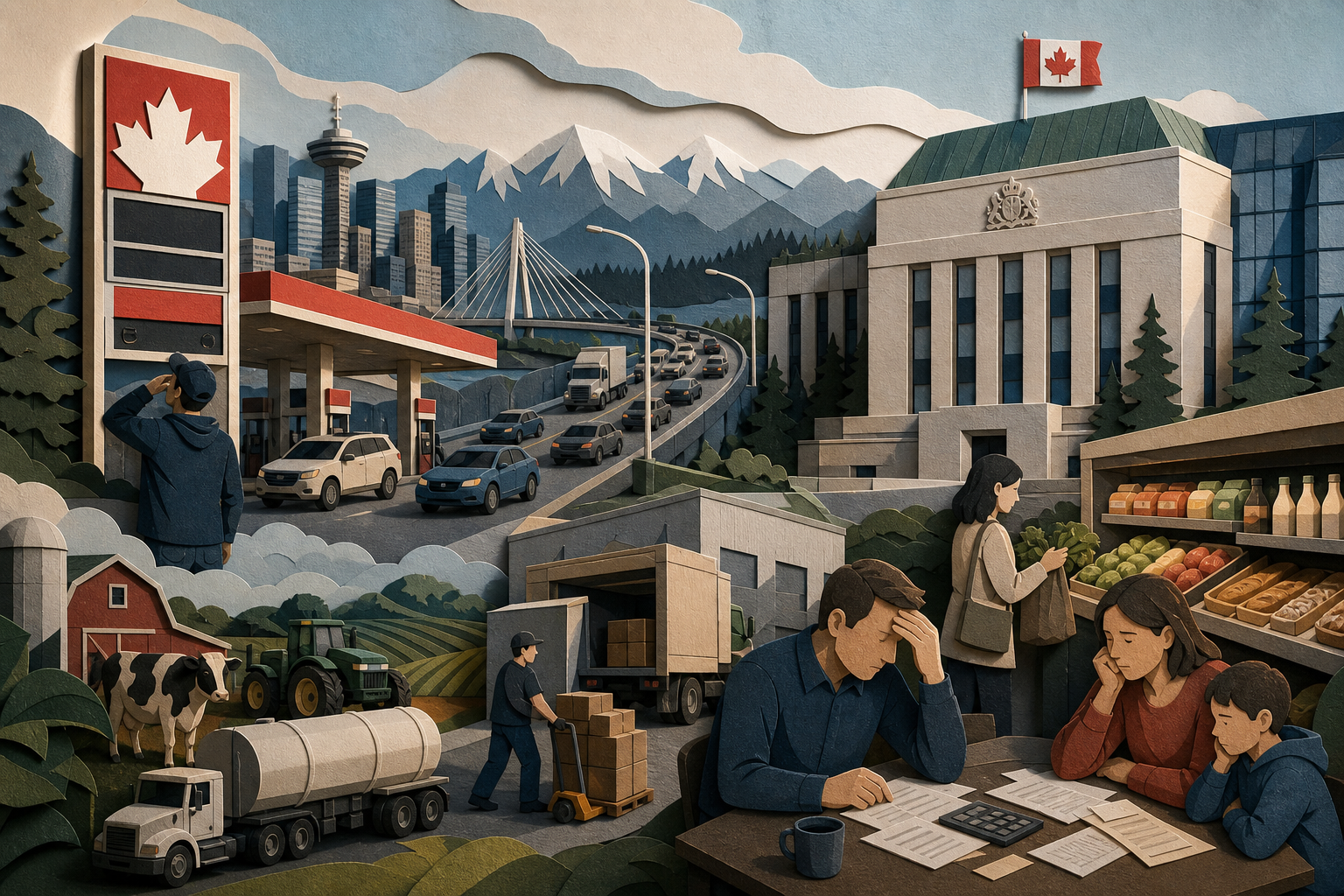
The Bank of Canada's Governing Council issued a warning this week: sustained high pump prices could force a return to rate hikes if elevated energy costs pass through to other goods and services, reversing the cautious easing cycle that began earlier this year. That threshold matters because gasoline is one of the few consumer prices visible on giant roadside signs, and high visibility breeds high anxiety.
The central bank's concern is what happens three steps downstream, not the pump price itself.
The pass-through problem
High fuel costs act as a hidden tax on the supply chain. In the Fraser Valley, where agriculture and logistics dominate the local economy, diesel and gasoline are input costs for dairy farms, poultry operations, and freight companies. When those costs stay elevated for months, businesses don't absorb them. They pass them along. The local delivery company raises rates. The grocery store raises the price of milk. The restaurant raises menu prices. The mechanic charges more for mobile service calls.
The Bank of Canada calls this "second-round effects." It's the mechanism by which a volatile commodity price becomes embedded inflation. Gas prices spike and fall all the time. But when they stay high long enough, they stop being a shock and start being a new baseline. Households adjust their expectations. Businesses adjust their pricing models. That's when the central bank has a problem.
British Columbia typically faces the highest gasoline prices in Canada due to limited refinery capacity and layered carbon pricing. British Columbia eliminated its consumer carbon tax effective April 1, 2025, removing this layer from household fuel costs. The federal Clean Fuel Regulations add another layer. Abbotsford and the Fraser Valley see slightly lower prices than Metro Vancouver proper, historically 10 to 15 cents per litre lower, because they sit outside the TransLink fuel tax boundary. That 18.5-cent-per-litre levy applies only in the Metro area.
The relief is modest. A commuter in Abbotsford still drives farther than someone in Vancouver. The savings on the tax vanish into the extra distance.
Monetary policy as a blunt tool
The Bank of Canada's policy interest rate controls demand. Higher rates make borrowing expensive, which slows spending, which cools inflation. That works when inflation is demand-driven, too many buyers chasing too few goods. Supply constraints are different. A supply problem cannot be solved by making money expensive. The Bank of Canada cannot produce more oil. It cannot lower global crude prices. It cannot eliminate provincial carbon taxes or federal fuel regulations. Raising interest rates to counter high gas prices is using a hammer to fix a plumbing leak. It might stop the flow, but only by breaking the pipe.
The irony is sharpest for Abbotsford households caught between two pressures. Homebuyers who locked in fixed rates during 2021–2022 and are now renewing face substantially higher rates. Higher mortgage payments already constrain household budgets. Add sustained high fuel costs to that, and the squeeze tightens. If the Bank of Canada hikes again to suppress inflation driven by energy, those same households absorb the cost twice: once at the pump, once in the mortgage payment.
The psychological anchor
Gasoline prices have disproportionate weight in inflation expectations because they are impossible to ignore. You see the number every time you drive past a station. That visibility matters.
When people see $1.85 per litre day after day, they expect everything else to get expensive. They ask for raises. They accept higher prices on other goods without pushback. Expectations become self-fulfilling. The Bank of Canada targets 2% inflation, the midpoint of a 1% to 3% control range, but if households stop believing that target is achievable, the target stops working.
The $1.80 threshold is not arbitrary. It's the point where fuel costs stop being a temporary squeeze and start reshaping behavior. The governing council is watching the pumps because what happens after the price signal reaches consumers drives the inflation rate, not because gasoline itself moves the CPI.




The Bank of Canada's Governing Council issued a warning this week: sustained high pump prices could force a return to rate hikes if elevated energy costs pass through to other goods and services, reversing the cautious easing cycle that began earlier this year. That threshold matters because gasoline is one of the few consumer prices visible on giant roadside signs, and high visibility breeds high anxiety.
The central bank's concern is what happens three steps downstream, not the pump price itself.
The pass-through problem
High fuel costs act as a hidden tax on the supply chain. In the Fraser Valley, where agriculture and logistics dominate the local economy, diesel and gasoline are input costs for dairy farms, poultry operations, and freight companies. When those costs stay elevated for months, businesses don't absorb them. They pass them along. The local delivery company raises rates. The grocery store raises the price of milk. The restaurant raises menu prices. The mechanic charges more for mobile service calls.
The Bank of Canada calls this "second-round effects." It's the mechanism by which a volatile commodity price becomes embedded inflation. Gas prices spike and fall all the time. But when they stay high long enough, they stop being a shock and start being a new baseline. Households adjust their expectations. Businesses adjust their pricing models. That's when the central bank has a problem.
British Columbia typically faces the highest gasoline prices in Canada due to limited refinery capacity and layered carbon pricing. British Columbia eliminated its consumer carbon tax effective April 1, 2025, removing this layer from household fuel costs. The federal Clean Fuel Regulations add another layer. Abbotsford and the Fraser Valley see slightly lower prices than Metro Vancouver proper, historically 10 to 15 cents per litre lower, because they sit outside the TransLink fuel tax boundary. That 18.5-cent-per-litre levy applies only in the Metro area.
The relief is modest. A commuter in Abbotsford still drives farther than someone in Vancouver. The savings on the tax vanish into the extra distance.
Monetary policy as a blunt tool
The Bank of Canada's policy interest rate controls demand. Higher rates make borrowing expensive, which slows spending, which cools inflation. That works when inflation is demand-driven, too many buyers chasing too few goods. Supply constraints are different. A supply problem cannot be solved by making money expensive. The Bank of Canada cannot produce more oil. It cannot lower global crude prices. It cannot eliminate provincial carbon taxes or federal fuel regulations. Raising interest rates to counter high gas prices is using a hammer to fix a plumbing leak. It might stop the flow, but only by breaking the pipe.
The irony is sharpest for Abbotsford households caught between two pressures. Homebuyers who locked in fixed rates during 2021–2022 and are now renewing face substantially higher rates. Higher mortgage payments already constrain household budgets. Add sustained high fuel costs to that, and the squeeze tightens. If the Bank of Canada hikes again to suppress inflation driven by energy, those same households absorb the cost twice: once at the pump, once in the mortgage payment.
The psychological anchor
Gasoline prices have disproportionate weight in inflation expectations because they are impossible to ignore. You see the number every time you drive past a station. That visibility matters.
When people see $1.85 per litre day after day, they expect everything else to get expensive. They ask for raises. They accept higher prices on other goods without pushback. Expectations become self-fulfilling. The Bank of Canada targets 2% inflation, the midpoint of a 1% to 3% control range, but if households stop believing that target is achievable, the target stops working.
The $1.80 threshold is not arbitrary. It's the point where fuel costs stop being a temporary squeeze and start reshaping behavior. The governing council is watching the pumps because what happens after the price signal reaches consumers drives the inflation rate, not because gasoline itself moves the CPI.
Sources
Read Next
Contract Rate or the 5.25% Floor: Which One Decides What You Can Buy
Rate Shopping Won't Fix a Qualification, Penalty or Cash Flow Problem
Salt Air and Ferry Schedules: 6 Carrying Costs of a Vancouver Island Cottage
Canadian Home Sales Fell Because Buyers Finally Did the Math