How US Tariffs Could Raise Your Mortgage Rate Without Touching Housing
The Bank of Canada sets the policy rate by watching inflation. When consumer prices accelerate, the overnight rate typically follows them up, pulling variable mortgage rates along. Fixed rates track the five-year Government of Canada bond yield, which moves on what investors think the central bank will do next and how much risk they see in holding Canadian debt. Trade policy sits two steps upstream from both.
A 50% tariff on Canadian exports to the United States does not touch a single house. It raises the cost of goods crossing the border, steel, auto parts, machinery, food, which feeds into the Consumer Price Index within six to twelve months as manufacturers and retailers pass the cost forward. Canada sends roughly 68% of its exports south, so any broad tariff is a direct shock to the price level. The inflationary pressure it creates forces the Bank of Canada into a choice: raise rates to cool prices, or hold them steady and watch inflation drift above the 1% to 3% control range.
That is the straightforward path. The less obvious one runs through the bond market, and it moves faster.
Why fixed rates could rise first
Bond yields do not wait for official rate announcements. They price in risk. A trade war between Canada and its largest trading partner adds a geopolitical premium to Canadian government debt. If global investors see instability, they demand a higher yield to compensate. The five-year GoC bond moves in response to that demand, and fixed mortgage rates, which are priced as a spread over that bond, move in lockstep.
This can create a paradox. In the early months of a tariff dispute, before inflation shows up in the data, the Bank of Canada might actually cut the overnight rate to prevent a recession. That would lower variable rates. But if bond yields are rising on risk premium, fixed rates climb at the same time. Two mortgage products moving in opposite directions, both reacting to the same trade shock.
The USMCA is up for mandatory review in 2026, so tariff threats are leverage in a negotiation that is already scheduled. Lenders price uncertainty into their spreads even when the benchmark yield holds flat. If the threat of tariffs persists without resolution, banks widen the margin between what they pay for money and what they charge borrowers. The borrower sees the widening in the spread as a higher rate at the bottom of the quote sheet.
The stagflation trap
The worst-case scenario for mortgage holders is stagflation: slowing growth with rising inflation. Tariffs can produce exactly that. A weakened Canadian economy sheds jobs and reduces demand for housing, but tariff-driven inflation keeps the central bank from cutting rates aggressively to stimulate growth. Homeowners face higher borrowing costs in a softer job market, with no policy relief because the Bank of Canada is still fighting price increases.
Currency plays a role here too. A tariff-damaged Canadian dollar makes imports more expensive, which keeps inflation sticky even as the domestic economy contracts. The Bank of Canada cannot cut rates without risking a further drop in the dollar, which would make inflation worse. That leaves mortgage rates elevated longer than the state of the housing market alone would justify.
Tariffs shape the forces that show up on a rate sheet. When tariffs move inflation and bond yields, mortgage rates follow, whether or not a single property changes hands.



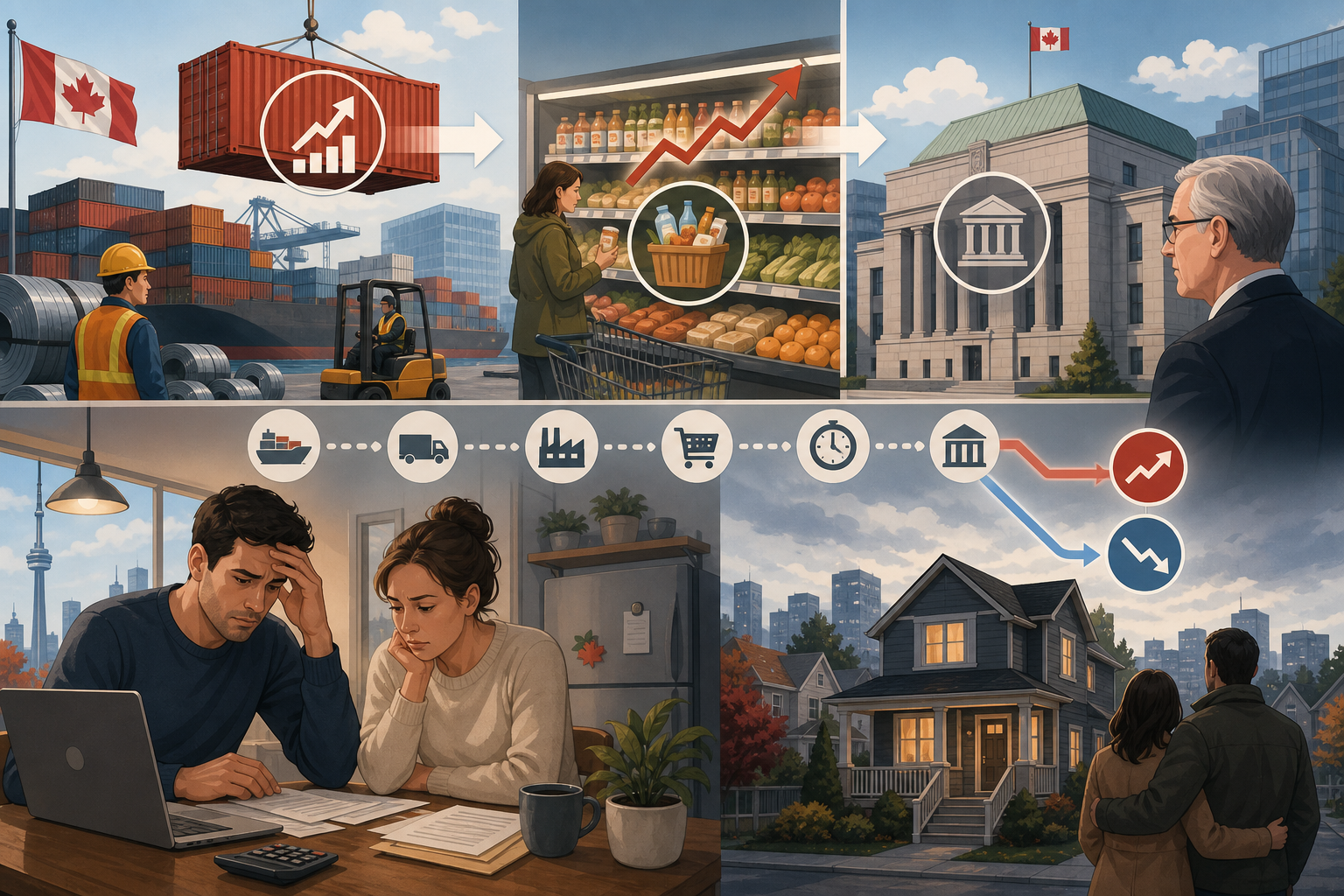

The Bank of Canada sets the policy rate by watching inflation. When consumer prices accelerate, the overnight rate typically follows them up, pulling variable mortgage rates along. Fixed rates track the five-year Government of Canada bond yield, which moves on what investors think the central bank will do next and how much risk they see in holding Canadian debt. Trade policy sits two steps upstream from both.
A 50% tariff on Canadian exports to the United States does not touch a single house. It raises the cost of goods crossing the border, steel, auto parts, machinery, food, which feeds into the Consumer Price Index within six to twelve months as manufacturers and retailers pass the cost forward. Canada sends roughly 68% of its exports south, so any broad tariff is a direct shock to the price level. The inflationary pressure it creates forces the Bank of Canada into a choice: raise rates to cool prices, or hold them steady and watch inflation drift above the 1% to 3% control range.
That is the straightforward path. The less obvious one runs through the bond market, and it moves faster.
Why fixed rates could rise first
Bond yields do not wait for official rate announcements. They price in risk. A trade war between Canada and its largest trading partner adds a geopolitical premium to Canadian government debt. If global investors see instability, they demand a higher yield to compensate. The five-year GoC bond moves in response to that demand, and fixed mortgage rates, which are priced as a spread over that bond, move in lockstep.
This can create a paradox. In the early months of a tariff dispute, before inflation shows up in the data, the Bank of Canada might actually cut the overnight rate to prevent a recession. That would lower variable rates. But if bond yields are rising on risk premium, fixed rates climb at the same time. Two mortgage products moving in opposite directions, both reacting to the same trade shock.
The USMCA is up for mandatory review in 2026, so tariff threats are leverage in a negotiation that is already scheduled. Lenders price uncertainty into their spreads even when the benchmark yield holds flat. If the threat of tariffs persists without resolution, banks widen the margin between what they pay for money and what they charge borrowers. The borrower sees the widening in the spread as a higher rate at the bottom of the quote sheet.
The stagflation trap
The worst-case scenario for mortgage holders is stagflation: slowing growth with rising inflation. Tariffs can produce exactly that. A weakened Canadian economy sheds jobs and reduces demand for housing, but tariff-driven inflation keeps the central bank from cutting rates aggressively to stimulate growth. Homeowners face higher borrowing costs in a softer job market, with no policy relief because the Bank of Canada is still fighting price increases.
Currency plays a role here too. A tariff-damaged Canadian dollar makes imports more expensive, which keeps inflation sticky even as the domestic economy contracts. The Bank of Canada cannot cut rates without risking a further drop in the dollar, which would make inflation worse. That leaves mortgage rates elevated longer than the state of the housing market alone would justify.
Tariffs shape the forces that show up on a rate sheet. When tariffs move inflation and bond yields, mortgage rates follow, whether or not a single property changes hands.
Sources
Read Next
Contract Rate or the 5.25% Floor: Which One Decides What You Can Buy
Rate Shopping Won't Fix a Qualification, Penalty or Cash Flow Problem
Salt Air and Ferry Schedules: 6 Carrying Costs of a Vancouver Island Cottage
Canadian Home Sales Fell Because Buyers Finally Did the Math