Holding Back or Hemmed In? What Unsold Condos Reveal About Developer Decisions in B.C.
Lenders typically want 70% to 80% of a condo project pre-sold before they release construction financing, and that single threshold explains much of what happens when a building is finished and the remaining suites are still unsold. The pre-sold units were priced two or three years earlier. The unsold ones are being priced into a different market.
The cost of waiting
Holding a finished unit is expensive. The construction loan keeps accruing interest, and the developer also pays property tax, insurance and strata fees on every empty suite. Consider an illustrative project with $40 million still outstanding on its construction loan at 6%. That is $200,000 a month in interest alone, before any of the carrying costs on individual units.
So the word "hoarding" fits poorly. A developer who wanted to restrict supply for profit would be paying a steep monthly fee for the privilege. The Bank of Canada began cutting policy rates from 5.0% in June 2024 and continued into 2025, reducing the overnight rate to 2.75% by April 2025, though borrowing costs remain well above the 2020-2021 lows. Nationally, CREA data cited by WOWA show sales down 6.7% year over year as of September 30, 2026, so the buyers who would have absorbed this inventory are thinner on the ground.
Why the price stays where it is
If waiting is costly, the obvious move is a discount. The reason it rarely happens is arithmetic spread across the whole building.
Suppose a pre-sale buyer contracted at $550,000, a figure within the roughly $530,000 to $560,000 range seen for Fraser Valley condo benchmarks over 2025-2026. If the developer then sells a neighbouring unit at 15% less, that is $467,500. When the first buyer's lender appraises the suite before closing, the comparable sale is sitting right there in the same building. The appraisal can come in short, the buyer may not be able to close, and a project that was relying on those closings to repay its construction lender now has a larger hole in it. This appraisal contagion binds the unsold units to the sold ones: a fire sale on a handful of suites puts the financing on the other 150 at risk.
That is why many developers also hold to loan covenants with their lenders that a discount could breach.
Discounts that don't look like discounts
What developers can do is change what the buyer receives without changing the recorded price. Common incentives include covered strata fees for a few years, a credit at closing, a free parking stall, or a furniture package. A $30,000 package leaves the registered sale price intact while lowering the buyer's effective cost.
For a buyer in Abbotsford, this means the headline price is an incomplete number. The useful comparison is the price net of incentives, set against what comparable resale condos are actually closing at.
Developers have a second pressure valve. Many are leasing unsold suites, sometimes as furnished or corporate rentals, to cover part of the monthly carrying cost. BC's Speculation and Vacancy Tax adds a wrinkle here, since exemptions for new inventory are conditional, and the tax's design can nudge a developer toward renting units it would rather have sold.
Where Abbotsford sits
The Fraser Valley condo market has moved toward balanced to buyer-friendly conditions, according to BCREA reporting. Abbotsford is particularly exposed because much of its condo demand comes from buyers priced out of Vancouver and Surrey. Those buyers are sensitive to qualifying rules, and federally regulated lenders still test mortgages at the contract rate or 5.25%, whichever is higher (as of September 22, 2026). A small rise in borrowing costs removes a meaningful share of them from the pool.
Buyers, meanwhile, are not eager to be first. Many suspect prices will soften further, and they are waiting. Developers wait because moving first is costly. Both sides are reading the same signals and reaching the same conclusion, which leaves the building half full.
What the standoff shows
Unsold condos are best read as the visible edge of a financing arrangement. The price on the sign is held in place by appraisals, covenants and pre-sale contracts signed in a different rate environment, and none of those can be adjusted unit by unit. The developer is not choosing between selling and holding so much as choosing which cost to absorb, and a year of interest is usually the smaller one.
Bank of Canada - The Bank of Canada kept policy restrictive through 2024 and 2025 - 2025-04-16. https://www.bankofcanada.ca/
Bond Yield Watch - federally regulated lenders still test mortgages at the contract rate plus 200 basis points or 5.25%, whichever is highe - 2026-09-22. https://bondyieldwatch.ca/



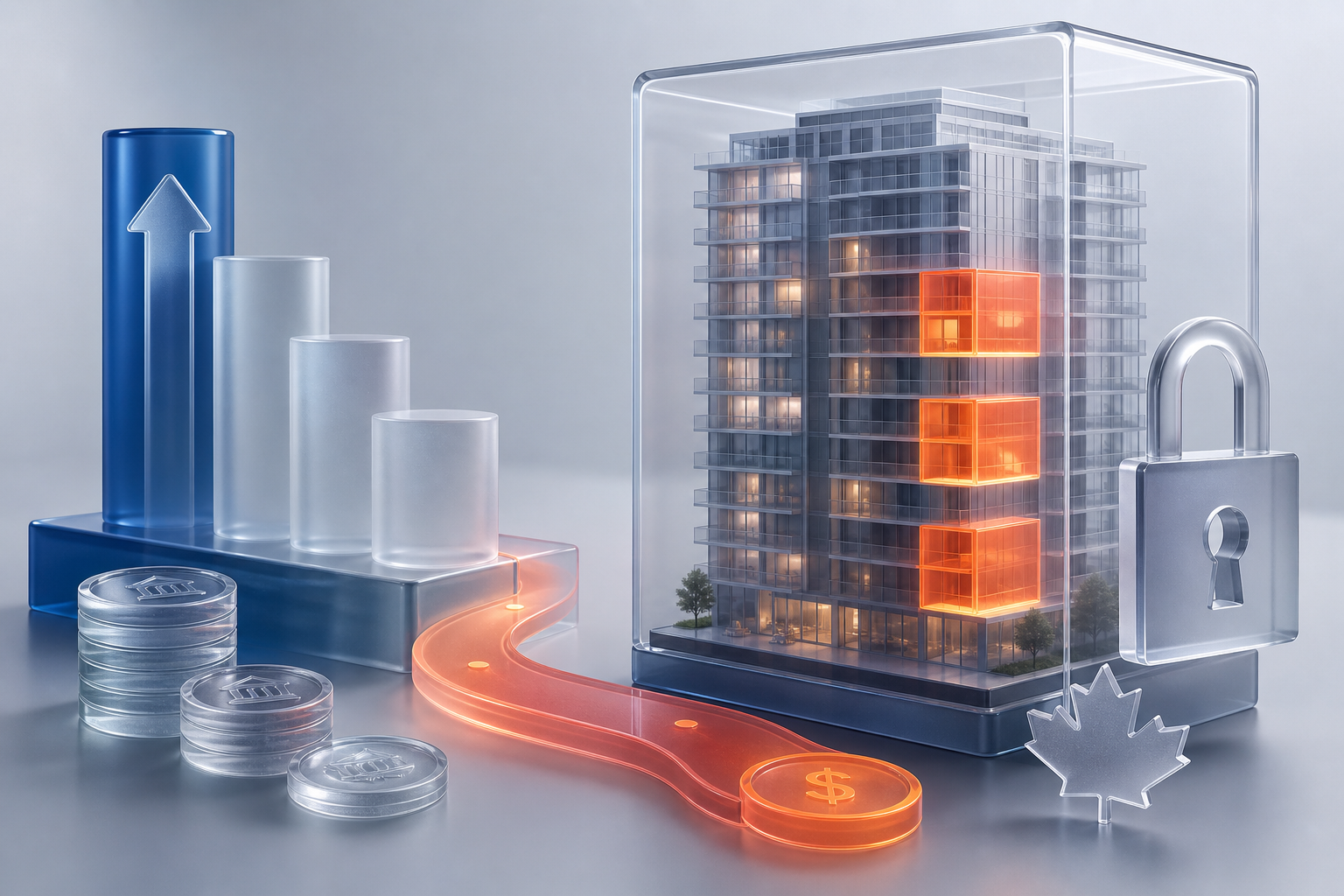

Lenders typically want 70% to 80% of a condo project pre-sold before they release construction financing, and that single threshold explains much of what happens when a building is finished and the remaining suites are still unsold. The pre-sold units were priced two or three years earlier. The unsold ones are being priced into a different market.
The cost of waiting
Holding a finished unit is expensive. The construction loan keeps accruing interest, and the developer also pays property tax, insurance and strata fees on every empty suite. Consider an illustrative project with $40 million still outstanding on its construction loan at 6%. That is $200,000 a month in interest alone, before any of the carrying costs on individual units.
So the word "hoarding" fits poorly. A developer who wanted to restrict supply for profit would be paying a steep monthly fee for the privilege. The Bank of Canada began cutting policy rates from 5.0% in June 2024 and continued into 2025, reducing the overnight rate to 2.75% by April 2025, though borrowing costs remain well above the 2020-2021 lows. Nationally, CREA data cited by WOWA show sales down 6.7% year over year as of September 30, 2026, so the buyers who would have absorbed this inventory are thinner on the ground.
Why the price stays where it is
If waiting is costly, the obvious move is a discount. The reason it rarely happens is arithmetic spread across the whole building.
Suppose a pre-sale buyer contracted at $550,000, a figure within the roughly $530,000 to $560,000 range seen for Fraser Valley condo benchmarks over 2025-2026. If the developer then sells a neighbouring unit at 15% less, that is $467,500. When the first buyer's lender appraises the suite before closing, the comparable sale is sitting right there in the same building. The appraisal can come in short, the buyer may not be able to close, and a project that was relying on those closings to repay its construction lender now has a larger hole in it. This appraisal contagion binds the unsold units to the sold ones: a fire sale on a handful of suites puts the financing on the other 150 at risk.
That is why many developers also hold to loan covenants with their lenders that a discount could breach.
Discounts that don't look like discounts
What developers can do is change what the buyer receives without changing the recorded price. Common incentives include covered strata fees for a few years, a credit at closing, a free parking stall, or a furniture package. A $30,000 package leaves the registered sale price intact while lowering the buyer's effective cost.
For a buyer in Abbotsford, this means the headline price is an incomplete number. The useful comparison is the price net of incentives, set against what comparable resale condos are actually closing at.
Developers have a second pressure valve. Many are leasing unsold suites, sometimes as furnished or corporate rentals, to cover part of the monthly carrying cost. BC's Speculation and Vacancy Tax adds a wrinkle here, since exemptions for new inventory are conditional, and the tax's design can nudge a developer toward renting units it would rather have sold.
Where Abbotsford sits
The Fraser Valley condo market has moved toward balanced to buyer-friendly conditions, according to BCREA reporting. Abbotsford is particularly exposed because much of its condo demand comes from buyers priced out of Vancouver and Surrey. Those buyers are sensitive to qualifying rules, and federally regulated lenders still test mortgages at the contract rate or 5.25%, whichever is higher (as of September 22, 2026). A small rise in borrowing costs removes a meaningful share of them from the pool.
Buyers, meanwhile, are not eager to be first. Many suspect prices will soften further, and they are waiting. Developers wait because moving first is costly. Both sides are reading the same signals and reaching the same conclusion, which leaves the building half full.
What the standoff shows
Unsold condos are best read as the visible edge of a financing arrangement. The price on the sign is held in place by appraisals, covenants and pre-sale contracts signed in a different rate environment, and none of those can be adjusted unit by unit. The developer is not choosing between selling and holding so much as choosing which cost to absorb, and a year of interest is usually the smaller one.
Sources
Read Next
Contract Rate or the 5.25% Floor: Which One Decides What You Can Buy
Rate Shopping Won't Fix a Qualification, Penalty or Cash Flow Problem
Salt Air and Ferry Schedules: 6 Carrying Costs of a Vancouver Island Cottage
Canadian Home Sales Fell Because Buyers Finally Did the Math